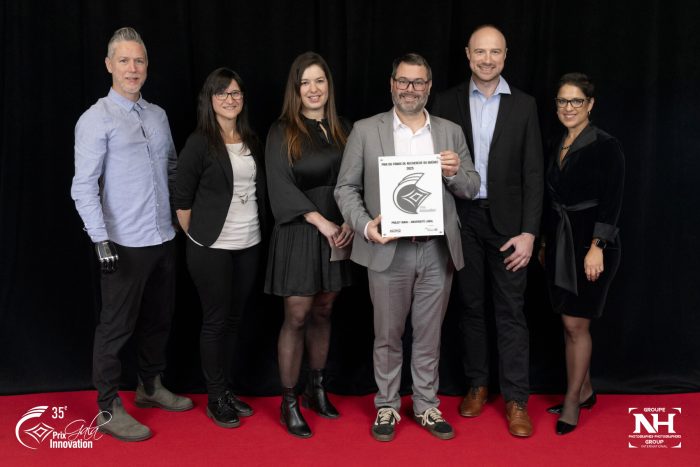
The MAIN project wins the Fonds de recherche du Québec Award at the ADRIQ Innovation Awards Gala
The MAIN project was awarded the Fonds de recherche du Québec (FRQ) Prize at the 35th edition of the ADRIQ Innovation Awards Gala, a prestigious recognition that highlights the excellence and impact of this collaborative research initiative led in particular by Cirris.
Led by principal investigator Benoît Gosselin, the MAIN project stands out for its resolutely intersectoral and human nature. According to him, this success is above all the result of a collective effort, bringing together partners who are hand prosthesis users, clinicians from the CIUSSS de la Capitale-Nationale, and a vast network of collaborators from the research, education, and industry communities.
Key partners include several FRQ strategic centers and groups, including Cirris, ReSMIQ, COPL, UNIQUE, CERVIM, and INTER, as well as collaborators from Laval University, ÉTS, and UQAM. The project can also count on the expertise of the TOPMED and Groupe CTT college centers, the support of its industrial partner Bio6 (Quebec City), and the essential commitment of students, interns, and research associates, who bring the project to life every day with their passion and creativity.
Several Cirris researchers are actively contributing to the MAIN project, including Alexandre Campeau-Lecours, Édith Martin, François Routhier, and Véronique Flamand, thereby strengthening the interdisciplinary expertise at the heart of this innovation.
The MAIN project aims to design the first smart hand prosthesis technology based on connected high-density myoelectric sensors (HD-EMG) and interactive deep learning strategies. This innovative approach will not only improve the user experience by compensating for disability more naturally, but also strengthen the neuromuscular capabilities of amputees and fully exploit the potential of their residual limbs, beyond the current limitations of prostheses.
Myoelectric prostheses already represent a major advance in rehabilitation, using electromyography (EMG) to non-invasively capture the electrical signals generated by muscle activity in order to control the movements of the prosthesis. The MAIN project aims to push the boundaries of this technology, thereby increasing its positive impact on both the quality of life of amputees and the socioeconomic development of Quebec.
Bringing together international experts from six FRQ-NT strategic clusters (UNIQUE, ReSMiQ, INTER, REPARTI, CQMF, and COPL), two FRQ-S networks (REPAR and Cirris), college technology transfer centers, public and industrial partners, and four university research chairs (including two Canada Chairs and two Canada-CIFAR Chairs), the MAIN project perfectly illustrates the strength of collaborative and interdisciplinary research supported by Cirris.
Photo credits : Association pour le développement de la recherche et de l’innovation du Québec (ADRIQ)